
PHY 111: Introduction to Physics
PROBLEMS
Q1. An object of mass 4 kg moves round a circle of radius 6 m with a constant speed of 12 m/s. Calculate:
(i) the angular velocity,
(ii) the force towards the centre.
Q2. An object of mass 10 kg is whirled round a horizontal circle of radius 4 m by a revolving string inclined to the
vertical. If the uniform speed of the object is 5 m/s, calculate:
(i) the tension in the string
(ii) the angle of inclination of the string to the vertical.
Q3. A racing-car of 1000 kg moves round a banked track at a constant speed of 108 km/hr. Assuming the total reaction at the wheels is normal to the track, and the horizontal radius of the track is 100 m, calculate the angle of inclination of the track to the horizontal and the reaction at the wheels.
Q4. Assuming that the mean density of the earth is 5500 kg/m3, that the constant of gravitation is 6.7x10⁻¹¹Nm2kg-2, and that the radius of the earth is 6400 km, find a value for the acceleration due to gravity at the earth's surface. Derive the formula used.
Q5. A copper wire, 200 cm long and 1.22 mm diameter, is fixed horizontally to two rigid supports 200 cm long. Find the mass in grams of the load which, when suspended at the mid-point of the wire, produces a sag of 2 cm at that point. Young's modulus for copper = 12.3x10¹⁰ Nm-2
Q6. In a materials testing laboratory, a metal wire made from a new alloy is found to break when a tensile force of 90.8 N is applied perpendicular to each end. If the diameter of the wire is 1.84 mm, what is the breaking stress of the alloy?
Q7. A 2150 kg mobile telephone network sattelite is in a circular orbit at a hieght of 780 km above the surface of the earth. What is the gravitational force on the satellite? What fraction is this of its weight at the surface of the earth?
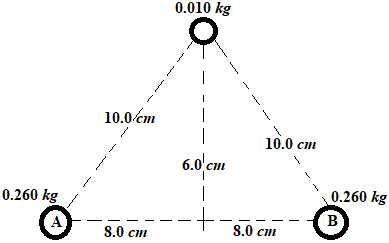
Q8. Two uniform spheres, each of mass 0.260 kg are fixed at points A and B. Find the magnitude and direction of the initial acclereation of a uniform sphere with mass 0.010 kg if released from rest at point P and acted on only by forces of gravitational attraction of the spheres at A and B.
Q9. The mass of Venus is 81.5% that of the earth, and its radius is 94.9% that of the earth:
a). Compute the acceleration due to gravity on the surface of Venus from these data.
b). What is the weight of a 5.00 kg rock on the surface of Venus?
Q10. When in orbit, a communication satellite attracts the earth with a force of 19.0 kN and the earth-satellite gravitational potential energy (relative to zero at infinite separation) is -1.39x10¹¹ J.
a). Find the satellite's altitude above the earth's surface.
b). Find the mass of the satellite.