
PHY 111: Introduction to Physics
GRAVITATION (cont.)
Weight
The weight w, of a body has been defined, according to Newton's second law, as the force that causes a body of given mass m, to fall freely towards the earth with acceleration g, that is,
$${w = mg,~~~~~~~~~~~~~~~~~~~~~~~~~~~~~~~~~~~~~~~~~~~~~~~(1) }$$
but in a more general term, we could also define the weight of a body as the total gravitational pull on the body by all other bodies in the universe.
A body on the earth surface is mainly pulled by the earth, all other pulls say, by the moon, the sun, planet mars etc, are negligible and could be ingnored.
Now, considering the earth as a uniform sphere with radius Re and mass Me, then the pull of the earth, that is, the weight of mass m, on the earth's surface will be given as
$${ w= \frac{GM_{e}m}{R_{e}^{2}} ~~~~~~~~~~~~~~~~~~~~~~~~~~~~~~~~~~~~~~~~~~~~~~~(2)}$$
Equating (1) and (2), we will have
$${mg=\frac{GM_{e}m}{R_{e}^{2}}}$$
$${g=\frac{GM_{e}}{R_{e}^{2}}~~~~~~~~~~~~~~~~~~~~~~~~~~~~~~~~~~~~~~~~~~~~~~~(3)}$$
From Eq. 3, we could estimate the mass of earth since G, had been calculated by Cavendish in 1798, Re has been calculated since the days of Eratosthenes and g could be calculated using
the pendulum method of Galileo. Thus,
$${M_{e}=\frac{gR_{e}^{2}}{G}}$$
using Re = 6380 km, g = 9.80 m/s2 and G = 6.673x10⁻¹¹ Nm2/kg2 we have
$${M_{e} = 5.98\times10^{24}~kg}$$
From the fact that we assumed the earth to be a uniform spherial body and knowing its radius then we could calculate its volume as
$${V_{e} = \frac{4}{3}\pi R^{3}_{e} = \frac{4}{3}\pi \left(6.38\times 10^{6}\right) = 1.09\times 10^{21}~m^{3}.}$$
Having known the mass and volume of earth, we could then go ahead and calculate the density ρe, of the earth, i.e.,
$${\rho_{e} = \frac{mass}{volume} = \frac{M_{e}}{V_{e}} = \frac{5.98\times 10^{24}}{1.09\times 10^{21}}\approx 5500~kg/m^{3}}$$
It should be noted that the density calculated here is the average density of the earth, as the density of the earth varies from the surface to the interior of the earth:
at the surface the density could be about 3000 kg/m3 while at the interior it could have a density of about 13000 kg/m3.
Gravitational Potential
The potential V, within the earth's gravitational field could be defined as numerially equal to the work done in taking a unit mass from infinity to the point of observation.
By convention, the potential at infinty V∞, is taken as zero (0).
Now, consider a mass m = 1 kg, under the influence of the earth's gravitational field with force F given by
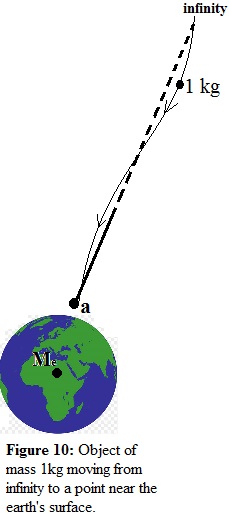 $${F = \frac{GM}{r^{2}}~~~~~~~~~~~~(note~that ~m ~= ~1~kg)}$$
For the work to be done on the mass m, it must move through distance δr, therefore,
$${Work = Force\times Distance}$$
that is,
$${\delta V = F\times \delta r}$$
$${V_{a}-V_{\infty} = \int_{\infty}^{a}\frac{GM}{r^{2}}dr}$$
$${+V_{a} = -GM\left[\frac{1}{r}\right]_{\infty}^{a}=-\frac{GM}{a}}$$
Snce V∞ = 0, the negative sign indicated that the potential at infinity is higher than the potential close to the surface.
For point a, very close to the surface we can say a ≈ r (radius of earth), i.e.,
$${V = -\frac{GM_{e}}{r}~~~~~~~~~~~~~~~~~~~~~~~~~~~~~~~~~~~~~~~~~~~~~~~~~~~~~~~~~~~~~~~~~~~~~~(4)}$$
Suppose an object is on the earth's surface and we need to move this object, of mass m, far away from the earth's surface such that the object
escapes from the influence of the earth's gravity, then
$${F = \frac{GM}{r^{2}}~~~~~~~~~~~~(note~that ~m ~= ~1~kg)}$$
For the work to be done on the mass m, it must move through distance δr, therefore,
$${Work = Force\times Distance}$$
that is,
$${\delta V = F\times \delta r}$$
$${V_{a}-V_{\infty} = \int_{\infty}^{a}\frac{GM}{r^{2}}dr}$$
$${+V_{a} = -GM\left[\frac{1}{r}\right]_{\infty}^{a}=-\frac{GM}{a}}$$
Snce V∞ = 0, the negative sign indicated that the potential at infinity is higher than the potential close to the surface.
For point a, very close to the surface we can say a ≈ r (radius of earth), i.e.,
$${V = -\frac{GM_{e}}{r}~~~~~~~~~~~~~~~~~~~~~~~~~~~~~~~~~~~~~~~~~~~~~~~~~~~~~~~~~~~~~~~~~~~~~~(4)}$$
Suppose an object is on the earth's surface and we need to move this object, of mass m, far away from the earth's surface such that the object
escapes from the influence of the earth's gravity, then
work done to acheive this = (mass of object)x(potential difference between infinity and the object's position)
 For an object, such as a rocket, being launched from the surface of the earth, we have the scenarios shown in Figure 11. For the object having launch velocity greater than the escape velocity (v > ve), the object will follow
an hyperbolic path and completely escapes the gravitational force.
For an object, such as a rocket, being launched from the surface of the earth, we have the scenarios shown in Figure 11. For the object having launch velocity greater than the escape velocity (v > ve), the object will follow
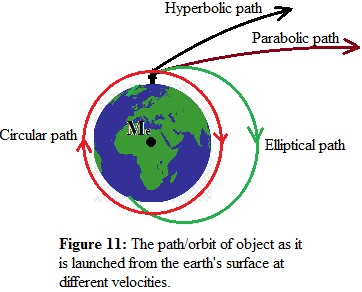
an hyperbolic path and completely escapes the gravitational force. If the object is launched with a velocity equal to the escape velocity (v = ve)then the object will follow a parabolic path and also escapes from the influence of the earth's gravity thereby, embarking on an inter-planetry journey!
For an object with launch velocity less than the escape velocity (v < ve), an elliptical path that will eventually crash the object back to earth will be followed. At a velocity of about 8 km/s , the launched object will follow a circular path around the earth and if there is no friction, the velocity of the object at launch will be the same when it returns to its initial point hence, it will follow the path over and over again and remain in circular orbit around the earth: this is the path of sattelites around the earth!
The concept of escape velocity could be used to explain the presence of atmosphere around some celestial bodies (e.g., earth, venus, jupiter, etc) while some others have very thin or no atmosphere at all (e.g., moon, pluto, mercury, etc).
Planetary Motion
In the solar system, the planets (Mercury, Mars, Earth, Venus, Jupiter, Saturn, Uranus and Neptune) move round the Sun using the gravitational force of attraction of the Sun. The realization that there are planets moving round the Sun as a center was made by many ancient astronomers including
Tycho Brahe and Nicolaus Copernicus but it was the German astronomer, Johannes Kepler who, between 1601 and 1619, clearly described the paths of these planets as they move around the Sun.
Before Kepler's time, astronomers had used circle to describe the path of planetry motion with attendant problems, but using loads of data left by his master Tycho Brahe,
Kepler was able to deduce that the path of planets around the is rather in the form of an ellipse rather than circular.
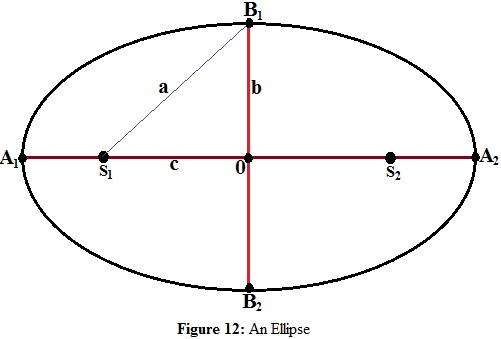 An ellipse is a deformed circle, with one axis longer than the other, as shown in Figure 12. The longer axis is called the major axis, while the shorter axis is called
the minor axis. An ellipse has two foci, S1 and S2 as shown in Figure 12. Eccentricity e, of an ellipse is a measure of the
circularity of the ellipse, it is defined as the ratio of the distance between one focus from the center of the ellipse to the distance between the focus and the top of the semi-major axis. From Figure 12 we have,
An ellipse is a deformed circle, with one axis longer than the other, as shown in Figure 12. The longer axis is called the major axis, while the shorter axis is called
the minor axis. An ellipse has two foci, S1 and S2 as shown in Figure 12. Eccentricity e, of an ellipse is a measure of the
circularity of the ellipse, it is defined as the ratio of the distance between one focus from the center of the ellipse to the distance between the focus and the top of the semi-major axis. From Figure 12 we have,
| Planet | Eccentricity |
|---|---|
| Mercury | 0.206 |
| Venus | 0.007 |
| Earth | 0.017 |
| Mars | 0.093 |
| Jupiter | 0.048 |
| Saturn | 0.056 |
| Uranus | 0.047 |
| Neptune | 0.009 |
The motion of planets around the Sun was described by Kepler's three laws:
Law 1:
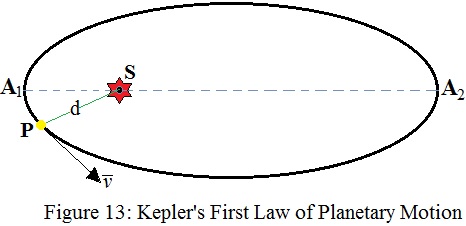
Each planet moves in an elliptical orbits with the Sun at one focus of the ellipse.
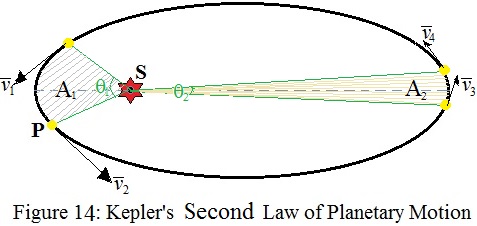
Law 2:
A line from the Sun to a given planet sweeps out equal areas in equal times.
Law 3:
The square of the period of revolution of a planet is proportional to the cubes of its mean distance from the Sun.
The third law was announced by Kepler in 1619, apparently without knowing the real natural reason behind his finding. It was Sir Isaac Newton in 1666 who analytically was able to verify the finding of Kepler.
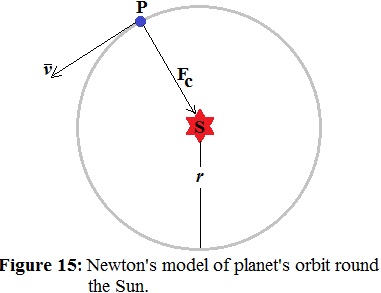 Newton considered the motion of planet P, with mass mp, the Sun S, with mass Ms at the center of the orbit and the radius of the orbit is r,
then the centripetal force Fc, keeping the planet in its orbit is given as
Newton considered the motion of planet P, with mass mp, the Sun S, with mass Ms at the center of the orbit and the radius of the orbit is r,
then the centripetal force Fc, keeping the planet in its orbit is given as