PHY 111: Introduction to Physics
Gravitation
In nature, there are four different type of interactions between matter:
- Electromagnetic interaction
- Strong interaction
- Weak interaction
- Gravitational interaction
The gravitational interaction acts between any massive objects, it is the interaction holding the earth and the moon together, it is the interaction that holds our solar system togethe, it is the interaction that holds our galaxy together, in short, it is the interaction that holds the universe as one! Without the gravitational interaction it would have been impossible for us to put satellites in space.
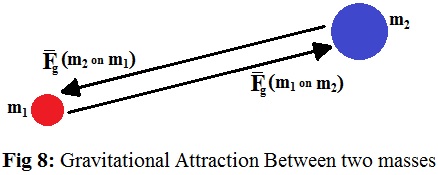 Based on centuries of gravitational studies, Sir Isaac Newton, in 1687, proposed the law of universal gravitational attraction that says:
Every partcle of matter in the universe attracts every other particle with a force Fg, that is directly proportional to the product of the masses (say m1 and m2) of the particles and inversely proportional to the square of the distance r, between them.
mathematically, we can write the above statement as: $${F_{g}\propto\frac{m_{1}\times m_{2}}{r^{2}}}$$ that is, $${F_{g}=G\frac{m_{1}\times m_{2}}{r^{2}}}$$ where G is a proportionality constant known as the gravitational constant. If the unit of Fg is in Newton (N), m1 and m2 in kilogram (kg) and r in meter (m), then G will be in the unit of Nm2/kg2. The current calculated value of G is 6.673(10)×10-11 Nm2/kg2.
The gravitational force Fg, between two masses always acts along the line joining the two masses in an action-reaction set, according to the Newton's third law, that is, no matter the difference in magnitude of the masses the force of attraction is always the same, for instance, a man on earth attracts the earth with the same force the earth attracts the man!
Question
When a person falls towards the earth, according to the Newton's law of gravitation, the person and the earth are supposed to accelerate towards each other but we always notice only the person accelerating towards the earth! is this a violation of the gravitational law? Explain your answer in detail.
Gravitational forces combine vectorially. If each of two masses exerts a force on a third, the total force on the third mass is the vector sum of the individual forces of the first two. This is called the principle of superposition of forces
.
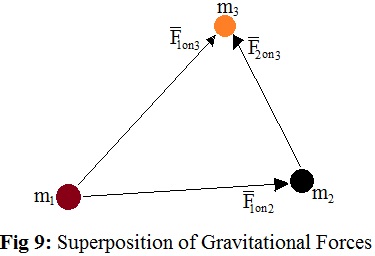 Total force on m3 = F1on3 + F2on3
Example:
Three identical masses of 500 kg each are placed on the x-axis. One mass is at x = -10 cm, one is at the origin, and one is at x = 40 cm. What is the net gravitational force (magnitude and direction) on the mass at the origin, due to the other two masses?
Solution
Before you start solving this problem you must realize that no picture has been given hence, you are required to imagine the mass arrangement on your own and put down the correct diagram for the sut-up!

Now, m2's pull on m1 F2on1, is given by $${\bar{F}_{2on1}=-G\frac{m_{1}m_{2}}{r^{2}} }$$ The negative sign indicates that the force pulls to the left (i.e., it indicates the direction), therefore, substituting the given values, also remember to change centimeter to meter! $${\bar{F}_{2on1}=-6.673\times10^{-11}\frac{500\times500}{(10\times10^{-2})^{2}}, }$$ that is, $${\bar{F}_{2on1}=-1.68\times10^{-3}~N }$$ Also $${\bar{F}_{3on1}=-6.673\times10^{-11}\frac{500\times500}{(40\times10^{-2})^{2}}, }$$ that is, $${\bar{F}_{3on1}=1.04\times10^{-4}~N }$$ Now, the total force on m3 will be given as $${\bar{F}_{T}=\bar{F}_{3on1} + \bar{F}_{2on1} }$$, that is, $${\bar{F}_{T}=1.04\times10^{-4} - 1.68\times10^{-3}, }$$ $${=- 1.58\times10^{-3}~N. }$$ The result shows that the resultant pull on m1 is to the left!