
PHY 111: Introduction to Physics
You are wellcome to this section. We have learnt some basic ideas from the previous section and these ideas together with some other
ideas we have in Physics, we will explore some applications.
Application 1:
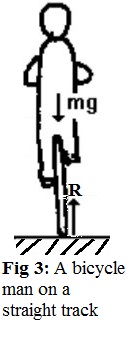
Let us consider a bike man on a road: if the road is straight, the bikeman and the bicycle
stand upright, as shown in Figure 3, the center of mass weight mg, is directly balanced by the reaction R, on the road, that is, R = mg,
this is according to the Newton's third law which says action and reaction are always equal and opposite for a body at equiliblium!
As the bicycle comes to a circular bend on the road, to maintain equilibrium, the bicycle man will need to bend slightly towards the center of the circle.
This scenario is shown in Figure 4.
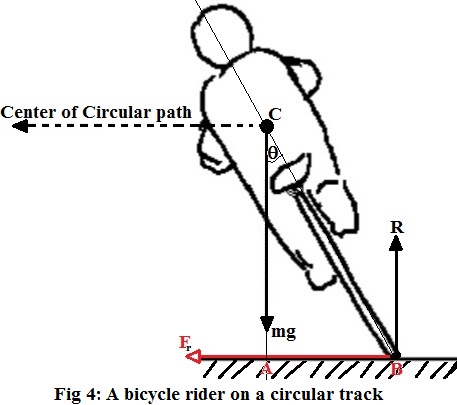
As the bicycle moves around the circular track, the center of mass C, moves towards the center of the circular path this movement brings the weight mg, towards the ground while the reaction force R tries to counter the movement of the center
of the weight by turning in anticlockwise direction about C. The frictional force Fr tries to straightens the bicycle by turning it about the center C, in a clockwise direction. Therefore, if we take moment about the center C, then we have,
that is,
$${F_{r}\cdot AC = R\cdot AB}$$ If AC = h and AB = a and also knowing that R = mg, then $${F_{r}\cdot h = mg\cdot a}$$ $${\frac{a}{h} = \frac{F_{r}}{mg}}$$ But if we consider ΔABC, then, we can clearly see that $${tan~\theta = \frac{a}{h}}$$ hence, $${tan~\theta = \frac{F_{r}}{mg}~~~~----------------1a}$$ Now, from the previous study, it is clear that Fr is the centripetal force maintaining the bicycle in the circular track, that is, $${F_{r} = \frac{mv^{2}}{r}~~~~-----------------2a}$$ where v, is the linear velocity of the bicycle around the circular track while r, is the radius of the circular track. If we now substitute Eq.2a into Eq.1a, then we have $${tan~\theta = \frac{v^{2}}{rg}~~~~-----------------3a}$$ It should be noted that when Fr is greater than the limiting friction then skidding occurs. In this case F > μmg or mg tan θ > μmg. Thus tan θ > μ is the condition for skidding.
Application 2:
In Appliation 1 above, we considered two-wheel drive, now let us consider a four-wheel drive on a circular track.
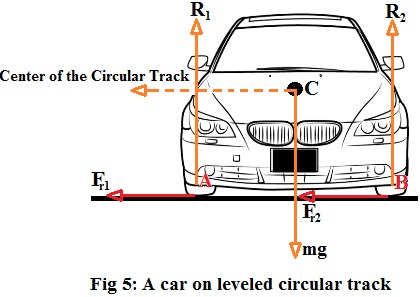
Consider a car, as shown in Figure 5 above, moving on a leveled ground but on a circular track (or road), if there is no skidding and the car is in equilibrium as it moves round the circular track, then
the frictional forces between the tire and the ground balance the centripetal force on the car towards the center of the circular track, therefore we have:
$${F_{r1}+F_{r2} = \frac{mv^{2}}{r}.~~~~-----------------4a}$$
Also, the weight of the car is balanced, according to Newton's third law, by the reactions at the tires, hence
$${R_{1}+R_{2} = mg.~~~~-------------------5a}$$
If the car is to spin as it moves round the circular path, it will spin about its center of gravity C. Since the car is not spining then
that is,
$${(F_{1r}+F_{r2})\times h+R_{1}\times a = R_{2}\times a ~~~~-----------6a}$$ where h is the height of the center of gravity C, above the ground and 2a is the distance between R1 and R2.
If we now solve Eqs 4a, 5a and 6a for R1 and R2, then we have $${R_{1}= \frac{1}{2}m\left(g-\frac{v^{2}h}{ra}\right) ~~~~---------------7a}$$ and $${R_{2}= \frac{1}{2}m\left(g+\frac{v^{2}h}{ra}\right) ~~~~---------------8a}$$ From Eq. 7a, it is possible that $${g = \frac{v^{2}h}{ra},}$$ if this happens then, R1 = 0 and R2 = mg with the result that the car then spins about its center of gravity C, in an anticlockwise direction towards the center of the circular path. In order to maintain stability the above car will need to bend, like the bicycle in Application 1. Unfortunately, this is not possible for a vehicle on four wheels . Instead of bending the car the road/track itself could be sloped around the curve. This sloping is called "banking" and the sloping angle is called "banking angle".
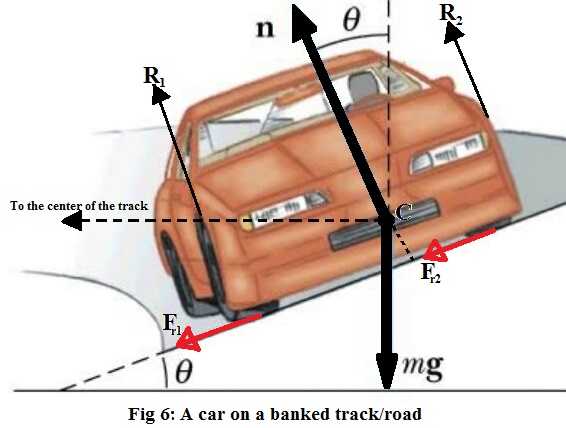
If we consider Figure 6, where we assumed that there is no slip at the wheels, if we resolve the two reactions vertically, then we will have, $${R_{1}cos \theta + R_{2}cos \theta = mg ~~~~----9a}$$ If we now resolve the reactions in the horizontal direction, we will have, $${R_{1}cos \theta + R_{2}sin \theta= \frac{mv^{2}}{r} ~~~~---10a}$$ If we now divide Eq. 9a by Eq. 10a, then we will have, $${tan \theta= \frac{v^{2}}{rg} ~~~~---------------11a}$$ If we now compare Eq. 11a with Eq. 3a, we will see that it is exactly the same reason that a cyclist bends at a curved track that a road is banked at a curved part! it should also be noted that the banking angle θ is for a particular velocity v.
Application 3:
Conical Pendulum
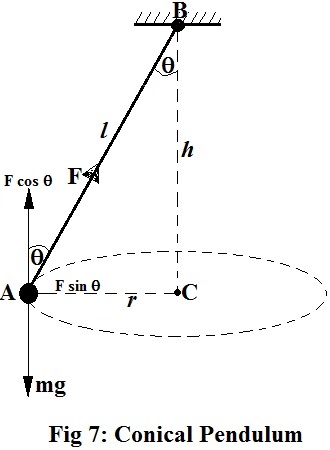
A conical pendulum is a pendulum that swings in a horizontal circle, as shown in Figure 7. Unlike the simple pendulum that oscilates in a vertical circular arc, conical pendulum always swings in a
circular horizontal plane.
Considering figure 7, the pendulum of length l is pulled at angle θ with tension F in the string, as shown. The weight mg of the pendulum bolb is vertically downward, as shown.
The tension F, could be resolved vertically as F cos θ and horizontally as F sin θ. According to Newton's third law,
the vertical tension resolution is balanced by the weight mg while the horizontal resolution is balanced by the centripetal force, thus
$${F cos \theta= mg ~~~~---------------12a}$$
and
$${F sin \theta= \frac{mv^{2}}{r} ~~~~---------------13a}$$
If we divide 13a by 12a and perform the neccessary trigonometry and algebra, we will have
$${v = \sqrt{rg tan \theta} ~~~~---------------14a}$$
but previously, we learnt that v = ω r and the period T = 2π/ω, hence
$${v = \frac{2\pi r}{T}}$$
therefore,
$${\frac{2\pi r}{T} = \sqrt{rg tan \theta}}$$
$${T = 2\pi \sqrt{\left(\frac{r cos \theta}{g sin\theta}\right)}}$$
But from ΔABC
$${sin\theta = \frac{r}{l}}$$
therefore,
$${T = 2\pi \sqrt{\left(\frac{l cos \theta}{g}\right)}~~~~--------------15a} $$
Eq. 15a, gives the period of circulation of the conical pendulum.
Now, if we square Eqs. 12a and 13a and then add the result, we will have
$${F^{2}(sin^{2} \theta + cos^{2} \theta) = m^{2}\left(\frac{v^{2}}{r}\right)^{2} + m^{2}g^{2}} $$
this then could be reduced to
$${F = m\sqrt{\left(\frac{v^{2}}{r}\right)^{2} + g^{2}}}$$
but we know that
$${tan \theta = \frac{v^{2}}{rg} = \frac{r}{h}}$$
therefore,
$${v^{2} = \frac{r^{2}g}{h}}$$
hence,
$${F = mg\sqrt{\left(\frac{r}{h}\right)^{2} + 1}~~~~--------------16a}$$
Equation 16a is the expression for estimating the tension in the string of a conical pendulum.