
PHY 111: Introduction to Physics
ELASTICITY
Molecules or atoms of materials are held together by either a covalent bond or ionic bond. In solid materials such as metals, this bonding
force is quite strong and it is responsible for the rigid shape of the metals.
If an external force is applied to solid material (perhaps in a wire form), the inter-molecular forces is influenced in such a way as to either squized or elongate the material.
The difference in length before the application of the external force and after, is called "extension e" of the material.
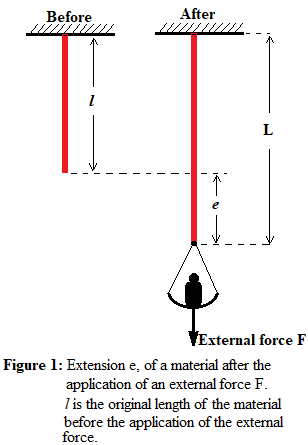 In 1660, Robert Hooke made a careful measurements of materials' extension under the influence of external force and he discorvered that if the force
is not very large, such that after the removal of the external force, the extended material return to its original shape/length, then the external force is directly proportional to the extension, that is,
In 1660, Robert Hooke made a careful measurements of materials' extension under the influence of external force and he discorvered that if the force
is not very large, such that after the removal of the external force, the extended material return to its original shape/length, then the external force is directly proportional to the extension, that is,
that is,
where k is a proportionality constant known as the 'constant of elasticity', which depends on the type, shape and dimension of the material under consideration.
Hooke's discorvery is summarily described in a physical law which states thus:
The extension is directly proportional to the load (or tension) applied on a material, provided the proportionality limit is not exceeded.
The above law is known as Hooke's Law.
If an experiment is performed and the value of the force F, plotted against the corresponding extension e, the graph will look as in Figure 2
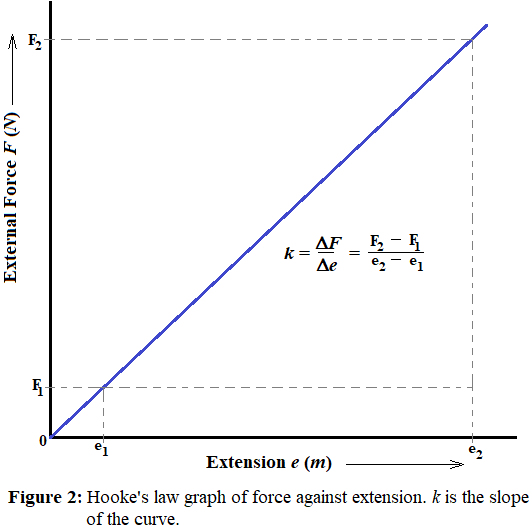
If the external force F, in the above experiment, becomes so large, it will be observed that if F is removed the material no longer returns back to its original length again! At thi point, the Hooke's law is no longer obeyed. If F is increased further, it will be observed that the material extends uncontrollably and then breaks. These observations follows the plot in Figure 3. Within the region OP, Hooke's law is obeyed and the material will elastically returned to its original length/shape after the removal of the external force/load. Point P is called the proportionality limit, that is, the point at which force/load stops being proportional to extension!
Point E is called elastic limit, beyond this point removal of the force/load does not bring back the material to its original length/shape again. The region OE is called elastic deformation region, because it is within this region that the removal of external force/load will bring back the material to its original length/shape. Between E and Y, the material becomes plastic, that is, if the load is removed the material will contract but all the extension is not recoverable.

It should be noted that not all solid (or psuedo-solid) materials follow the graph of Figure 3. The materials that follow this graph are able to be drawn out into a thin wire and various shapes without breaking or cracking. This group of materials are said to be ductile material. For example, most metals such as copper, gold, silver, very low carbon steel, rubber etc.
Other materials do not get beyond the yield point (Y) before they break or crack under applied force, these type of materials are said to be brittle, that is, they break easily under tension, for example, high carbon steel/cast iron, glass, tungsten etc.
Tensile Stress and Tensile Strain
In Figure 1 above, application of force F, causes the material to extend by e. If we cut the material horizontally, the area of
the seen is called the cross-sectional area A of the material, the ratio of the applied force to the cross-sectional is reffered to as the stress of the material;
i.e., the tensile stress is defined as the force applied per unit cross sectional area of a wire/material
$${tensile ~stress=\frac{Applied ~Force~(F)}{Cross ~Sectional ~Area~(A)}}$$
that is,
$${tensile ~stress=\frac{F}{A}~~~~~~~~~~~~~~~~~~~~~~~~~~~~~~~~~~~~~~~~~~~~~~~~~~~~~~~~~~~~~~~~~2}$$
It should be noted that if the unit of force is Newton(N) and the unit of Area is squared-meter (m2), then the unit of tensile stress is
Newton per squared-meter (Nm-2).
Tensile strain is defined as the ratio of the extension (e), as a result of applied force, to the original length (l) of the wire/material,
$${tensile ~strain=\frac{extension~(e)}{original ~length~(l)}}$$
that is,
$${tensile ~stress=\frac{e}{l}~~~~~~~~~~~~~~~~~~~~~~~~~~~~~~~~~~~~~~~~~~~~~~~~~~~~~~~~~~~~~~~~~~3}$$
We should take note that since both e and l are both measure in meter (m) then tensile strain has no unit!
If tensile stress is plotted against tensile strain then the graph of Figure 3 will be obtained with the y-axis as tensile stress and the x-axis as the tensile strain.
Within the elastic limit, the modulus of elasticity called Young's modulus (E) is defined as the ratio of tensile stress to tensile strain,
$${Young's~modulus=\frac{tensile ~stress}{tensile ~strain}}$$
From (2) and (3) above, we have
$${E=\frac{F/A}{e/l}}$$
that is,
$${E=\frac{Fl}{Ae}~~~~~~~~~~~~~~~~~~~~~~~~~~~~~~~~~~~~~~~~~~~~~~~~~~~~~~~~~~~~~~~~~~~~~~~~~~~~~~~4}$$
Young's modulus is of the same unit as the tensile stress, i.e., Nm-2.
Example
What load, in kilogram, must be applied to a steel wire 6 m long and diameter 1.6 mm to produce an extension of 1 mm? (Young's modulus for steel = 2.0x10¹¹ N/m2; accleration due to gravity = 9.8 m/s2).Solution
Appealing to equation 4 will solve our problem, but before doing that, all the values not in SI units need to be converted. From the question, only those given in millimeter needs convertion to meter, thus:
Diameter = 1.6 mm = 1.6x10⁻³m
and
Extension = 1 mm = 1x10⁻³m
Now, from equation 4, we have
$${F=\frac{AEe}{l}}$$ in order to continue we will need to calculate the area A, that is,
$${A=\pi r^{2} = \pi\left(\frac{1.6\times10^{-3}}{2}\right)^{2}=2.01\times10^{-6}~m^{2}}$$ We now go back to the main problem, that is
$${F=\frac{2.01\times10^{-6}\times2.0\times10^{11}\times1\times10^{-3}}{6}}$$ $${=67.0 ~N}$$ But the question requires our answer to be given in kilogram! This we achieve by appealing to Newton's Second law, i.e.,
$${F=ma=mg}$$ which will give
$${m=\frac{F}{g}=\frac{67.0}{9.8}=6.8~kg}$$ That is, the applied load is 6.8 kg.
Energy Stored in an Elastic Material
For an elastic material under external force F, and within its elastic limit, the plot of force F, against an extension e, is as shown below in Figure 4: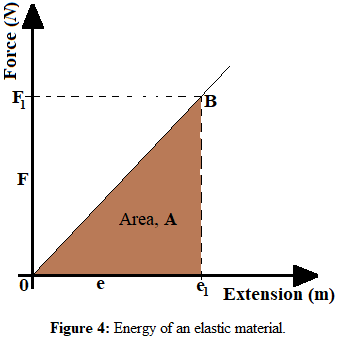
The area A, under the above curve, that is, the triangle 0Be1 is given as
$${Area,~ A=\frac{1}{2}\times base\times height}$$ $${~~~~~~~~=\frac{1}{2}\times 0e_{1}\times 0F_{1}}$$ $${=\frac{1}{2}Fe}$$ This area A, is defined as the work done by the force F in extending a material be an extension e, that is, $${Work, ~W=\frac{1}{2}Fe.}$$ The work done W, is the energy stored in the material as it is kept under the extension F, if F is given in the unit of Newton(N) and the extension in the unit of metre (m) then the work done W is in the unit of Joule (J). Previously, we saw that F could be given in terms of the Young's modulus E as, $${F=\frac{EAe}{l}}$$ hence, $${W=\frac{1}{2}\frac{EAe^{2}}{l}.}$$ If we know the original length of the material, then we can find its volume as $${Volume =Cross-section ~area \times Original ~length}$$ $${~~~~~~~=A \times l}$$ We can now calculate the energy per unit volume as $${Energy~per~unit~volume=\frac{W}{Al}}$$ $${=\frac{1}{2}Fe\div Al}$$ $${=\frac{1}{2}\frac{F}{A}\times \frac{e}{l}}$$ but $${Tensile ~Stress=\frac{F}{A}}$$ and $${Tensile ~Strain=\frac{e}{l}}$$ hence, $${Energy~per~unit~volume=\frac{1}{2}\times Tensile ~Stress \times Tensile ~Strain.}$$
Bulk Modulus
Bulk modulus is usually applied to changes in the volume of fluid as they respond to variations in temperature and pressure, hence bulk strain is defined thus,$${Bulk ~Strain=\frac{change ~in~volume}{original~volume}}$$ while the bulk stress is defined as $${Bulk ~Stress=\frac{change ~in~applied ~force}{surface ~area}=change~in~pressure.}$$ The bulk modulus K, is given by
$${K=\frac{bulk ~stress}{bulk ~strain}}$$ $${~=\frac{change~in~pressure}{change~in ~volume/original~volume}}$$ According to Boyle's law, increase in pressure leads to decrease in volume, hence $${K=-\frac{\Delta p}{\Delta V/V}}$$ $${~=-V\frac{\Delta p}{\Delta V}}$$ For an infinitesimally small changes, we have $${K=-V\frac{dp}{dV}.}$$ Again, according to Boyle's law, during an isothermal change, the product of pressure and volume is a constant, that is, $${p\cdot V=constant}$$ differentiating the above gives $${pdV+Vdp=0}$$ $${p+V\frac{dp}{dV}=0}$$ that is, $${p=-V\frac{dp}{dV}}$$ therefore, $${p=K}$$ Hence, isothermal bulk modulus is equal to the pressure.
During an adiabatic changes, Boyle's law is written as $${p\cdot V^{\gamma}=constant}$$ where γ is the ratio of the specific heat capacity of the gas at constant pressure cp and constant volume cv, that is, $${\gamma=\frac{c_{p}}{c_{v}}}$$ upon differentiation, we have $${\gamma pV^{\gamma - 1}+V^{\gamma}\frac{dp}{dV}=0}$$ that is, $${\gamma p=K}$$ that is, adiabatic bulk modulus = γp.
Velocity of Sound
The velocity v, of sound in a material depends on:1) its density ρ
2) its modulus of elasticity E
that is, $${v=kE^{x}\rho^{y}}$$ by dimensional analysis, we can show that $${x =\frac{1}{2}~~~~~~~~and~~~~~~~~y = -\frac{1}{2}}$$ and if we set k = 1, then $${v=\sqrt{\frac{E}{\rho}}}$$ The above expression is true for a solid material. For fluids, the Young's modulus E is replaced with the bulk modulus K and for gas, the adiabatic bulk modulus γp is used, that is $${v=\sqrt{\frac{\gamma p}{\rho}}}$$
Shear Modulus
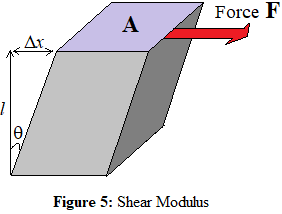
The shear modulus or modulus of rigidity is the deformation of a solid when it experiences a force parallel to one of its surfaces while its opposite face experiences an opposing force, such as friction.
$${shear ~modulus=\frac{shear ~stress}{shear ~strain}}$$ $${G=\frac{\tau_{xy}}{\gamma_{x}}=\frac{F/A}{\Delta x/l}}$$ $${=\frac{Fl}{A\Delta x}}$$ Δx is the transverse displacement
l is the initial length.
The SI unit of shear modulus is Pascal (Pa). A fluid could be defined as a material with zero shear modulus, that is, any force can deform its surface.