
PHY 121: Introduction to Physics
INTRODUCTION TO OPTICS
Outline
Reflection at plane and curved surfaces.Laws of reflection.
Total internal reflection.
Refraction through prisms.
Spectrometer, spectra.
Lenses; dispersion, aberration, optical instruments.
Defects of vision.
The branch of physics which deals with the behaviour and properties of light is called OPTICS. The knowledge of optics enable us to to understand the observable colours of the sky, the rainbow and the design of useful gadgets such as telescopes, microscopes, different types of camera, eyeglasses and even the working of animal eyes. This knowledge also enable us to design modern communication cables, that is, the fibre optics cables that transmit information at the speed of light.
Nature of Light
Isaac Newton and many other scientists believed that light consisted of streams of particles which they called corpuscles.
These corpuscles were beleived to be emitted by the source of light and Galileo tried unsuccesfully to measure the speed of these corpuscles!
By around 1665, the wave theory of light started to emerge and by 1873, James Clerk Maxwell together with the work of Heinrich Hertz, in 1887, were able to conclusively
show that light is indeed an electromagnetic wave.
By 1930, several works in qauntum physics had, again, shown that light could also be effectively described in terms of particle, called photon.
The energy E, carried by light could be calculated if we know the frequency f of the light as
$${E=h\cdot f}$$
where h is a constant, called Planck's constant and has a value of about 6.63x10⁻³⁴ Js. The speed of light could also be calculated if we know the wavelength λ as well as the frequency, as
$${c=\lambda \cdot f}$$
From analysis of all measurements up to 1983, the speed of light has been found to be around 2.99792458x10⁸ m/s.
Often, the concept of a wave front is used to describe wave/light propagation. A wave front can be defined as the locus of all
adjacent points at which the phase of vibration of a physical quantity associated with the wave is the same.
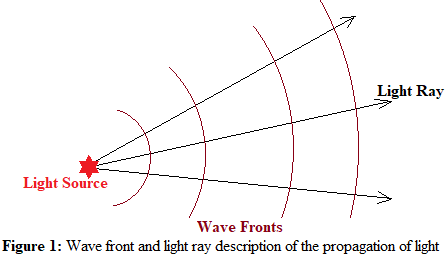
To describe the directions in which light propagates, it is often convinient to represent a light wave by rays rather than by wave fronts.
In a particle theory of light, rays are the paths of the particles. Rays could be defined, if we consider wave theory of light, as an imaginary line along the direction of travel of the wave.
Light rays are always perpendicular to the wave front of light.
The branch of optics that uses light rays to describe propagation of light is called geometric optics while the branch of optics that uses wave behaviour is called physical optics.
Reflection of Light
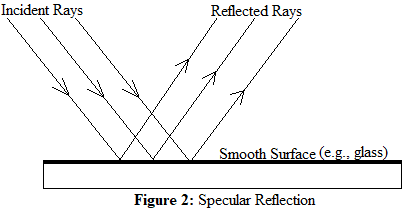
A light wave incident on a plane surface will "bounce" away from the surface in such a away that depends on the nature of the plane surface. The "bouncing" of light from the plane surface is technically reffered to as reflection. If the surface is such that it is very very smooth, the rays falling on it are all reflected in a definite direction: this type of reflection is called specular reflection.
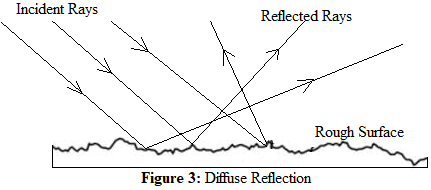
If the surface is such that it is very rough then the incident rays are reflected in different directions. Such reflection is reffered to as diffuse reflection. Most objects in our environment are visible to us because they diffusely reflected light rays falling on them.
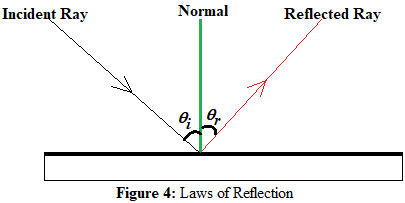
Experimental works on incident light rays on a smooth surfaces have shown that:
- The incident, reflected and the normal to the surface all lie in the same plane.
- The angle of incident θi, is equal to the angle of reflection θr, for all wavelengths and for any pair of materials .
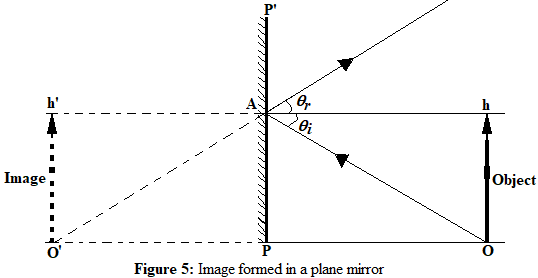
Using the laws of reflection, the image formed by a plane mirror could be illustrated as in Figure 5, where it could be seen that the image formed has the following properties:
- The image is virtual (a virtual image is an image which can not be formed on a screen or it is formed by apparent intersection of light rays).
- The image has the same size as the object, that is, it has a magnification of one! .
- The image is formed at the same distance as the object is from the mirror.
- The image is laterally inverted.
Reflection at Curved Surfaces
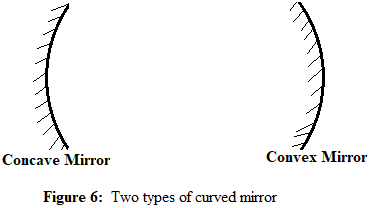
There are two types of curved mirrors to be considered:
- Concave Mirror (or converging mirror)
- Convex Mirror (or diverging mirror)
The features of curved mirrors are shown on Figure 7 and enumerated below:
- Pole (P): this is the vertex (or the center) of the mirror.
- Centre of curvature (C): This is the centre of the sphere of which the mirror is part.
- The Principal Axis : This is the line that passes through the pole and the centre of curvature in such a away that the mirror is divided into two equal parts.
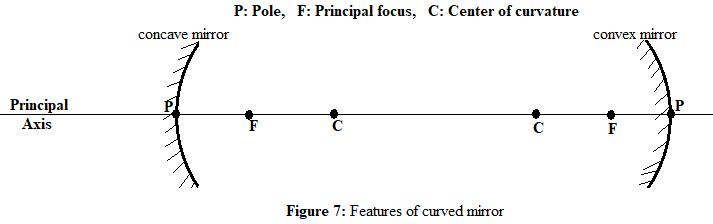
When rays of light that are parallel and close to the principal axis is reflected by the curved mirror, the point from which the rays converge (for concave mirror) or diverge (for convex mirror) is refrred to as the principal focal point (F).

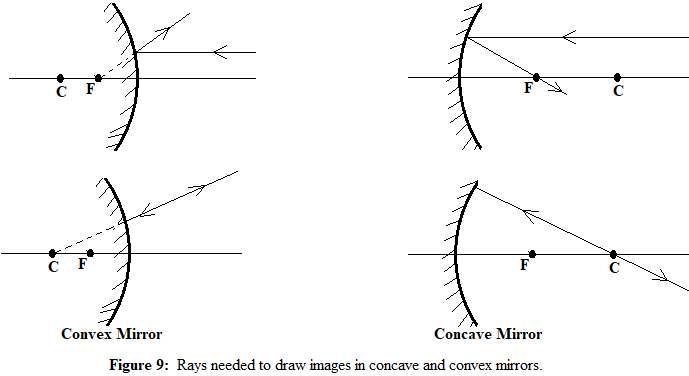
For images to be drawn with ray diagrams there are at least two major rays that must be mastered:
- The ray of light parallel and close to the principal axis. After reflection this ray must pass through the principal focal point. It should be noted that if the ray reverses direction by first passing through the principal focal point, then after reflection will then propagates parallel and close to the principal axis.
- The ray passing through the centre of curvature. This ray will be reflected back along the same path.
Now, using the above principles, we will draw and describe the images formed by concave mirror when the object is placed at various positions from the mirror:
1) Object between the Pole and the Principal Focal Point
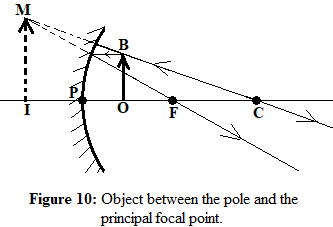
From Figure 10 above, it will be observed that the image IM is:
- Upright
- Magnified
- Virtual
2) Object at the Principal Focal Point
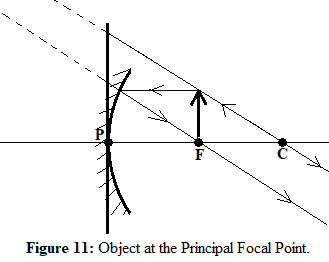
From Figure 11, we could clearly see that the image formed is at infinity and nothing could be clearly said about the property of the image order than it is formed at infinity!
3) Object between the Principal Focal Point and the Centre of Curvature
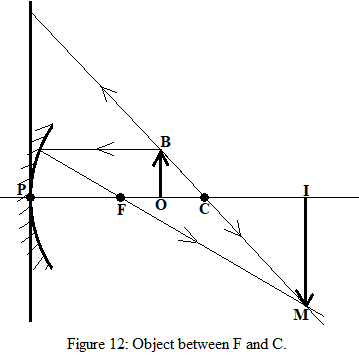
From Figure 12, it could be seen that the image IM, is:
- Inverted
- Magnified
- Real
4) Object at the Centre of Curvature

From Figure 13, it could be seen that the image, is:
- Inverted
- The same size as the object
- Real
- It is formed at the same position as the object
5) Object beyond the Centre of Curvature
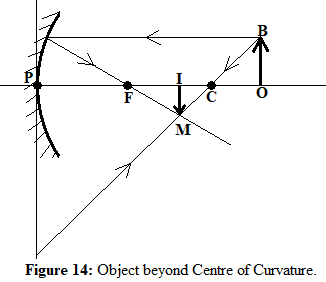
From Figure 14, it could be seen that the image IM, is:
- Inverted
- Diminished
- Real
Image formed by a Convex Mirror
As could be seen from Figure 15, the image formed by a convex mirror is always upright, diminished and virtual, no matter what position the object is, in front of the convex mirror, the image always have the stated properties.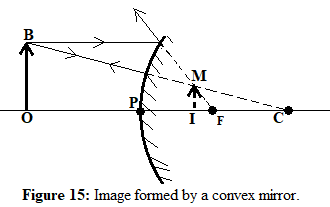
Analytical Method of Finding Images in Curved Mirrors
For analytically describing the images formed by curved mirrors, the formula below could be used $${\frac{1}{s}+\frac{1}{s^{'}}=\frac{1}{f}}$$ and for calculating the magnification m, of the mirror, we could use $${m=\frac{s^{'}}{s}=-\frac{y^{'}}{y}}$$ In the above two equations, s is the obect distance from the mirror; s' is the image distance from the mirror; f is the fical length of the mirror; y' is the height of the image; y is the height of the object.In using the above equations, the underlined sign conventions must be adhered to:
- All distances are measured from the pole of the mirror.
- The distances measured infront of the reflecting surface is positive.
- The distances measured behind the mirror, i.e., in the mirror, are taken as negative.
- Heights measured perpendicular to the principal axis, in the upward direction are taken as positive.
- Heights measured perpendicular to the principal axis, in the downward direction are taken as negative.
- The size of the object is always taken as positive, but image size is positive for erect image and negative for an inverted image.
- The magnification is positive for erect (and virtual) image, and negative for an inverted (and real) image.
Example 1
An object is placed 15 cm in front of a concave mirror of radius of curvature of 50 cm. Calculate the image distance from the mirror.
Solution
s = 15 cm
f = r/2 = 50/2 = 25 cm
s' = ?
Now, $${\frac{1}{s^{'}}+\frac{1}{s} = \frac{1}{f} }$$ therefore, $${s^{'} = \frac{fs}{s-f} }$$ Substituting the values, we have $${s^{'} = \frac{25\times 15}{15-25} }$$ therefore, $${s^{'} = -37.5 ~cm }$$ The above result shows that the image is formed behind the mirror, i.e., it is virtual. This is in agreement with the ray diagram, since the object is placed between the pole and the principal focal point.